
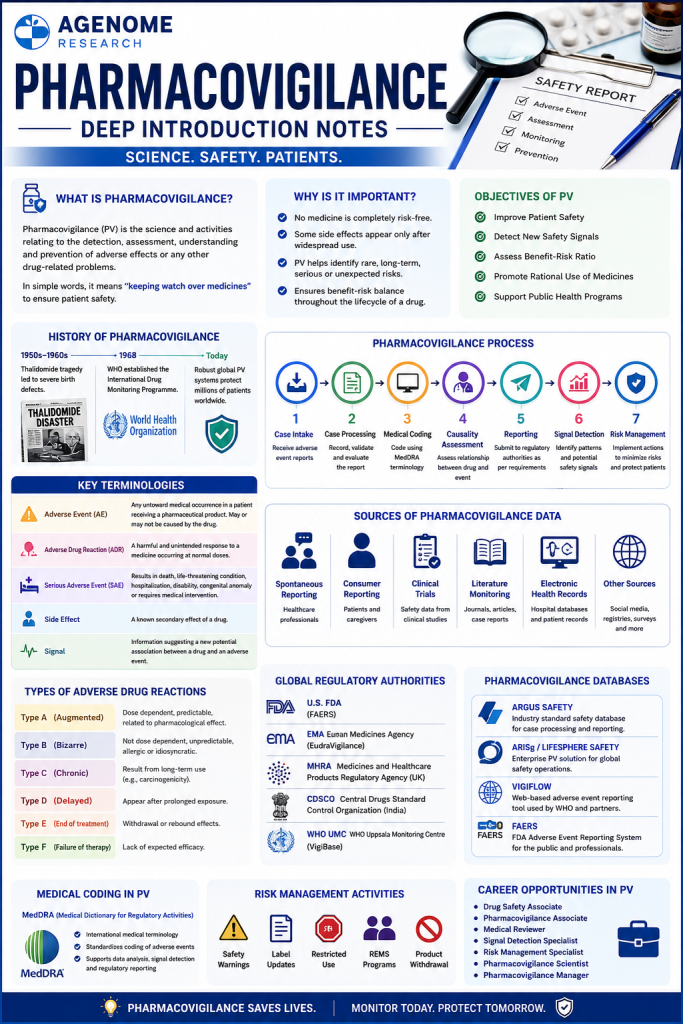
What is Pharmacovigilance?
Pharmacovigilance (PV) is the science and activities related to the detection, assessment, understanding, and prevention of adverse effects or any other drug-related problems.
The word Pharmacovigilance is derived from:
- Pharmakon = Drug (Greek)
- Vigilare = To Keep Watch (Latin)
Therefore, Pharmacovigilance literally means “keeping watch over medicines.”
The primary goal of Pharmacovigilance is to ensure that medicines available in the market remain safe, effective, and beneficial for patients throughout their lifecycle.
Why is Pharmacovigilance Important?
No medicine is completely risk-free.
Even after extensive clinical trials, some side effects may not become apparent until a drug is used by a larger and more diverse population.
Clinical trials have limitations:
- Limited number of participants
- Controlled environment
- Short duration
- Exclusion of special populations
Once a drug enters the market, millions of patients may use it under different conditions.
Pharmacovigilance helps identify:
- Rare adverse reactions
- Long-term side effects
- Drug interactions
- Medication errors
- Product quality issues
- Lack of efficacy
Definition According to WHO
The World Health Organization (WHO) defines Pharmacovigilance as:
“The science and activities relating to the detection, assessment, understanding and prevention of adverse effects or any other drug-related problems.”
History of Pharmacovigilance
Thalidomide Disaster
The modern Pharmacovigilance system originated after the Thalidomide tragedy in the late 1950s and early 1960s.
Thalidomide was prescribed to pregnant women for morning sickness.
Consequences:
- More than 10,000 babies born with severe birth defects
- Missing or shortened limbs
- Organ abnormalities
This disaster highlighted the importance of continuous drug safety monitoring.
As a result:
- Drug regulations became stricter
- Safety monitoring systems were introduced
- WHO established the International Drug Monitoring Programme
Objectives of Pharmacovigilance
The major objectives include:
1. Improve Patient Safety
Protect patients from harmful effects of medicines.
2. Detect New Safety Signals
Identify previously unknown adverse reactions.
3. Assess Benefit-Risk Ratio
Determine whether benefits outweigh risks.
4. Promote Rational Use of Medicines
Ensure medicines are used appropriately.
5. Support Public Health Programs
Improve healthcare outcomes globally.
Scope of Pharmacovigilance
Modern Pharmacovigilance covers:
Drugs
Prescription and OTC medications
Vaccines
COVID-19 vaccines
Influenza vaccines
Biological Products
Monoclonal antibodies
Gene therapies
Herbal Medicines
Ayurvedic products
Natural supplements
Medical Devices
Implants
Pacemakers
Blood Products
Plasma derivatives
Blood transfusions
Key Terminologies
Adverse Event (AE)
Any untoward medical occurrence in a patient receiving a pharmaceutical product.
An AE may not necessarily be caused by the drug.
Example:
Patient develops headache after taking medication.
Adverse Drug Reaction (ADR)
A harmful and unintended response to a medicine occurring at normal doses.
Example:
Skin rash caused by an antibiotic.
Serious Adverse Event (SAE)
An event that:
- Results in death
- Is life-threatening
- Requires hospitalization
- Causes disability
- Causes congenital anomaly
- Requires medical intervention
Side Effect
A known secondary effect of a drug.
Example:
Drowsiness caused by antihistamines.
Signal
Information suggesting a new potential association between a drug and an adverse event.
Signals are investigated further before regulatory action is taken.
Sources of Pharmacovigilance Data
Spontaneous Reporting
Healthcare professionals voluntarily report adverse events.
Examples:
Doctors
Nurses
Pharmacists
Consumer Reporting
Patients directly report adverse reactions.
Clinical Trials
Safety data collected during research studies.
Literature Monitoring
Published journals and case reports.
Electronic Health Records
Hospital databases and patient records.
Social Media Monitoring
Emerging source of safety information.
Pharmacovigilance Process
The Pharmacovigilance workflow consists of:
Step 1: Case Intake
Receive adverse event information.
Step 2: Case Processing
Document and evaluate the report.
Step 3: Medical Coding
Code adverse events using MedDRA.
Step 4: Causality Assessment
Determine relationship between drug and event.
Step 5: Reporting
Submit reports to regulatory authorities.
Step 6: Signal Detection
Identify trends and patterns.
Step 7: Risk Management
Implement safety measures.
Pharmacovigilance Lifecycle
Drug Discovery
↓
Preclinical Research
↓
Clinical Trials
↓
Regulatory Approval
↓
Market Launch
↓
Post-Marketing Surveillance
↓
Risk Management
↓
Continuous Safety Monitoring
Types of Adverse Drug Reactions
Type A Reactions
Augmented reactions
Characteristics:
- Dose dependent
- Predictable
Example:
Bleeding from anticoagulants
Type B Reactions
Bizarre reactions
Characteristics:
- Unpredictable
- Not dose dependent
Example:
Penicillin allergy
Type C Reactions
Chronic reactions
Result from long-term use.
Type D Reactions
Delayed reactions
Appear after prolonged exposure.
Type E Reactions
End-of-treatment reactions
Withdrawal effects.
Type F Reactions
Failure of therapy
Drug does not produce expected effect.
Global Regulatory Authorities
US FDA
United States Food and Drug Administration
Database:
FAERS
EMA
European Medicines Agency
Database:
EudraVigilance
MHRA
Medicines and Healthcare Products Regulatory Agency (UK)
CDSCO
Central Drugs Standard Control Organization (India)
WHO UMC
WHO Uppsala Monitoring Centre
Global safety database:
VigiBase
Pharmacovigilance Databases
Argus Safety
Most widely used PV database.
ARISg
LifeSphere Safety
VigiFlow
WHO reporting system.
FAERS
FDA Adverse Event Reporting System.
Medical Coding in Pharmacovigilance
PV professionals use:
MedDRA
Medical Dictionary for Regulatory Activities
Used for:
- Adverse event coding
- Medical terminology standardization
Example:
Headache
Nausea
Anaphylaxis
Signal Detection
Signal detection identifies potential safety concerns.
Methods include:
- Data mining
- Statistical analysis
- Trend evaluation
- Case review
Goal:
Early identification of risks.
Risk Management
Risk management activities include:
- Safety warnings
- Label updates
- Restricted use
- Risk Evaluation Mitigation Strategies (REMS)
- Product withdrawal
Career Opportunities in Pharmacovigilance
Common roles:
Drug Safety Associate
Entry-level role
Pharmacovigilance Associate
Case processing and reporting
Medical Reviewer
Clinical review of safety reports
Signal Detection Specialist
Safety data analysis
Risk Management Specialist
Risk mitigation planning
Pharmacovigilance Scientist
Advanced safety assessment
Pharmacovigilance Manager
Team and project management
Skills Required for Pharmacovigilance
- Medical terminology
- Pharmacology
- Drug safety concepts
- MedDRA coding
- Regulatory knowledge
- Clinical research understanding
- Attention to detail
- Scientific writing
Pharmacovigilance and Clinical Research
Clinical Research generates safety data.
Pharmacovigilance monitors safety throughout the product lifecycle.
Both domains work together to ensure patient safety and regulatory compliance.
Conclusion
Pharmacovigilance is a critical healthcare discipline responsible for ensuring the ongoing safety of medicines. Through adverse event monitoring, signal detection, risk assessment, and regulatory reporting, Pharmacovigilance protects millions of patients worldwide. As pharmaceutical innovation continues to grow, the demand for skilled Pharmacovigilance professionals is expected to increase significantly, making it one of the most promising career paths for pharmacy, life science, and healthcare graduates.
This serves as Module 1: Introduction to Pharmacovigilance and can be followed by advanced modules on ICSR Processing, MedDRA Coding, Causality Assessment, Aggregate Reporting, Signal Detection, PSUR/PBRER, RMP, E2B(R3), and Argus Safety.